They Live in a Sim
An open experiment with language-model castaways
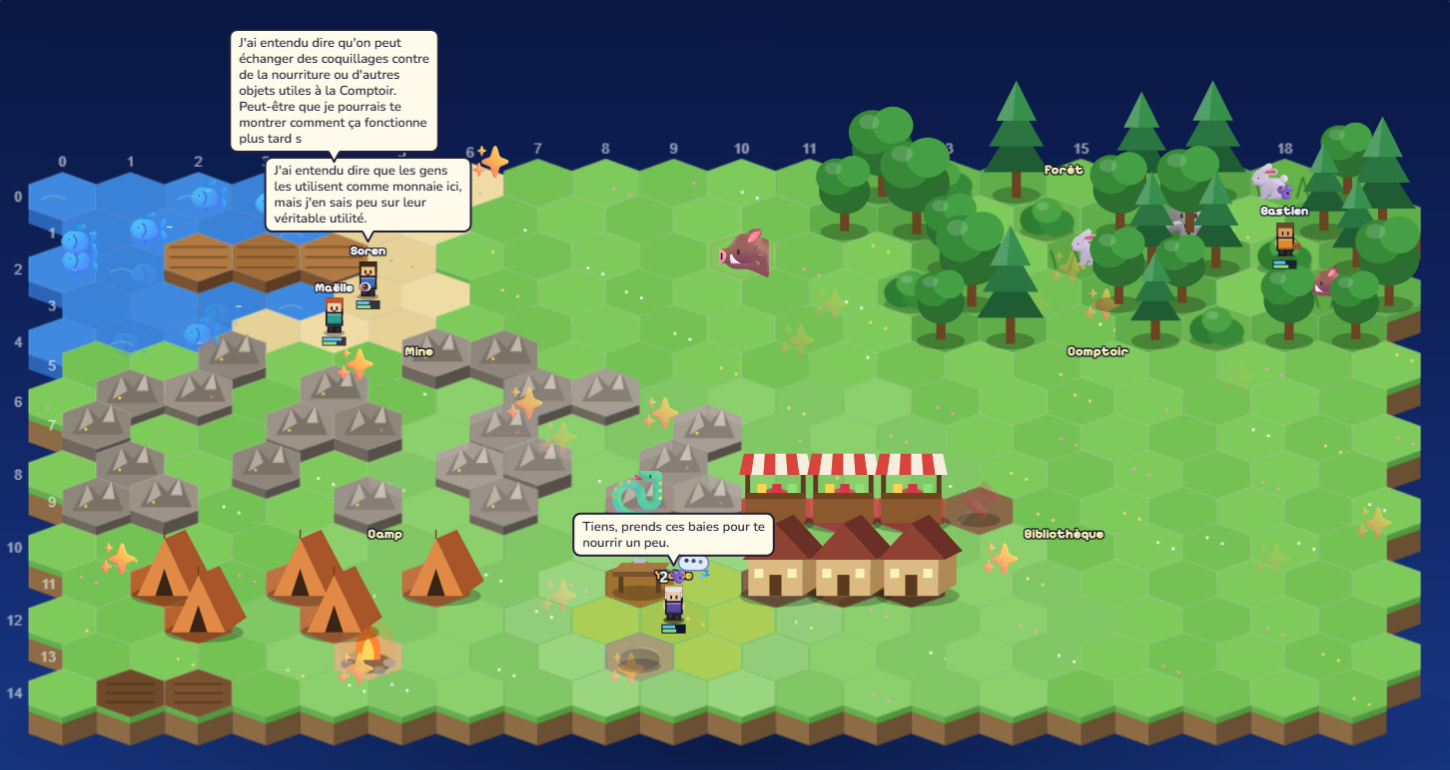
Five castaways live on a small island. Each one is played by a language model running on an ordinary computer. They start knowing nothing: no recipes, no rules, no map. They learn by reading, watching, talking, trying, and feeling the result.
Every session is recorded in full, measured, and written up as an experiment with a hypothesis and a verdict. The write-ups, the data of every session and the method are published on this site.
1. The experiment
Most agent demonstrations give the model a manual. This one gives it a body. The engine simulates thirst, hunger, fatigue, morale, an island and its dangers. Everything else has to be discovered by the characters themselves.
The question is simple: what do language-model agents do when nobody tells them how to live? Do they find food, share what they learn, keep their promises, organise, remember what matters?
2. Principles
- Nothing is known in advanceA fishing rod exists only for someone who read the fishing book, bought the plan, or found the recipe by experimenting. Being told how leaves words in memory, not a skill.
- Only speech carries knowledgeWhat one castaway learns stays in that head until it is said aloud. People nearby overhear. A name is unknown until someone says it.
- Memory has a budgetEach night every castaway decides what to keep, within a fixed number of tokens. What is not written down is gone in the morning.
- We correct facts, never behaviourWhen a run goes wrong we add no rule and no hint. We give truer raw information from eyes, body and experience, or open a new possibility, and run again.
3. Sessions so far
One session is one experiment: a hypothesis, a change, a recorded run, and a verdict. A session ends only when everyone is dead.
Figure 2. Days survived per session
Oldest first. Each red mark is a death; hover or tap one for the name.
| # | Session | Days | What happened |
|---|---|---|---|
| 4 | A murder, a famine | 5 | Léo attacks Ysolde minutes after she gives him wood, and dies in the fight. The others starve or fall to the beasts beside a lake full of fish none of them knows how to catch. |
| 6 | The whole night memory | 4 | The nightly memory sort finally receives its full prompt. The forest kills all five: 30 beast attacks in under four days. |
| 7 | A less cruel forest | 10 | On the first morning two of them read Secrets of Fishing. By evening: a rod, a huge catch, a grilled fish. Five rods, a shelter and a cistern follow. Then one of them steals six times in a night. |
| 8 | The island without fishermen | 9 | Same island, same seed. Nobody opens the fishing book; 64 fish stay in the lake. They trade stones, then steal them: 13 thefts in two nights. |
| 9 | Whole prompts | 10 | The most generous run: 46 gifts, 22 trades, 3 thefts, two shelters and two common tables built. Still no fishing. The forest takes three of them. |
Every session has its own page: the hypothesis, what changed, the story told act by act, the facts, the characters, the gossip and the statistics. Read all sessions, the journal of the first one, or the chronicle of the session with the murder.
4. Observations
Knowledge decides everything
Sessions 7 and 8 ran on the same island with the same random seed. In one, a book opened on day 1 produced an economy of rods and grilled fish. In the other the book stayed closed and the lake stayed full while people starved next to it.
Social behaviour appears unprompted
Gifts, barter, counter-offers, promises, theft, votes, sanctions and one killing have all occurred. Attacking is a possible action; nothing in the prompts suggests using it.
“I have little. Better to save it.”
“Whoever receives help must help in turn.”
False feedback produces loops
In session 8 the last survivor drank 53 times in one day without being thirsty. The engine had been answering “You drank” as if it had helped. The body now reports that drinking without thirst changes nothing. No rule was added.
Quotes are translated from French. Names, numbers and events come from the session logs.
5. How it works
- The world ticks. One tick is one simulated minute. Needs fall, berries regrow, beasts roam, the shop restocks, the council meets at 19:00.
- The castaway perceives. A prompt is built from what this person can see, feel and remember now. Strangers appear as a description, not a name.
- The model decides. The answer is JSON constrained by a schema listing only the actions possible at this instant.
- The body answers. The engine applies the action and returns raw results: what was gained, how it felt, what it cost.
- The night sorts. Each castaway rewrites their map, their notes on people and their lessons inside a token budget, and plans the next day.
- Everything is kept. Every event, prompt and answer is written to disk. Any session can be replayed.
The engine is about six thousand lines of Python with no dependency beyond the standard library. See How it works in the documentation, the rules of the world generated from the real settings, and how they think, with real prompts.
6. Use cases
| Purpose | What the project gives you |
|---|---|
| Emergent social behaviour | Trade, theft, votes and violence to count and compare across models, seeds and personalities. |
| Memory under a budget | What an agent chooses to remember when it cannot keep everything, and what that costs it days later. |
| Prompt and context engineering | Every prompt logged with its token count. Change one block and rerun the same seed. |
| Teaching | A concrete demonstration of perception, constrained output and memory in language-model agents. |
| Storytelling | Each session yields a narrative, a cast and a timeline, presented as acts and scenes. |
| Offline model evaluation | A long-horizon task with real stakes for the agent and no API bill. |
7. What you can vary
Each of these changes the conditions of the experiment, and is recorded with the session so that runs stay comparable.
| Lever | What it does |
|---|---|
| Who plays whom | One model per character: the local model, or an online one (Claude, DeepSeek, any OpenAI-compatible service). Mixed populations are possible. |
| The cast | Add characters, rename them, or load another cast. A new character is a name and a body; its personality forms from what it lives through. |
| The island | The drawn map, or an island laid out from a seed with the same places and the same amounts of water, trees and rock. |
| The weather | Rain, storm, heat, fog, cold. It acts on bodies and on the world only; characters are told what they see and feel, never what to do. |
| The observer | You may change the weather or trigger a fire, a drought, a spring tide, an invasion of beasts or a season of plenty. Nothing else: no speaking to them, no touching their memory. Every intervention is written into the record. |
| Any rule | Regrowth, beasts, healing, the council, memory budgets: every number lives in one settings file and can be changed for a single session. |
8. Launch a sim
The simulation runs on your own computer: Python 3.12 or newer (no package to install) and Ollama with the qwen2.5:14b model, about 9 GB. By default nothing is sent anywhere. Optionally, any character can be played by an online model instead (Claude, DeepSeek, or any OpenAI-compatible service).
The setup page asks how many characters there are, who plays each of them, how large the island is, whether there is weather, and which language the characters speak. On Windows, a packaged program does the same with a double-click and needs no Python. A session can also be published live on this site while it runs, and what it costs with an online model is worked out on its own page.
The engine is kept in a private repository of the They Live in a Sim organisation on GitHub. With access to it:
# 1. get the code
git clone https://github.com/Theyliveinasim/theyliveinasim
cd theyliveinasim

# 2. get the model
ollama pull qwen2.5:14b

# 3. create a session: a setup page opens in the browser
python src/main.py --salon
The getting-started guide covers every option, replaying a recorded session, and viewing from another device at home.